
What if the most dangerous moment in DeFi is not when a protocol is hacked, but when a user approves a transaction that looks ordinary? Consider a US-based investor moving between an Ethereum lending market, a layer-2 exchange, and a token bridge during a busy afternoon. The assets may sit on different networks, yet the human error is the same: the user sees a familiar token name, clicks quickly, and fails to understand what the wallet is authorizing.
This is where a multi-chain wallet such as Rabby becomes interesting. Its value is not simply that it holds assets across several networks. The deeper proposition is that a wallet can act as an interpretation layer between a decentralized application and the person signing. That can improve decision-making—but it cannot make an unsafe protocol safe, reverse a malicious approval, or protect a user who ignores every warning. Security begins with the wallet, but it does not end there.
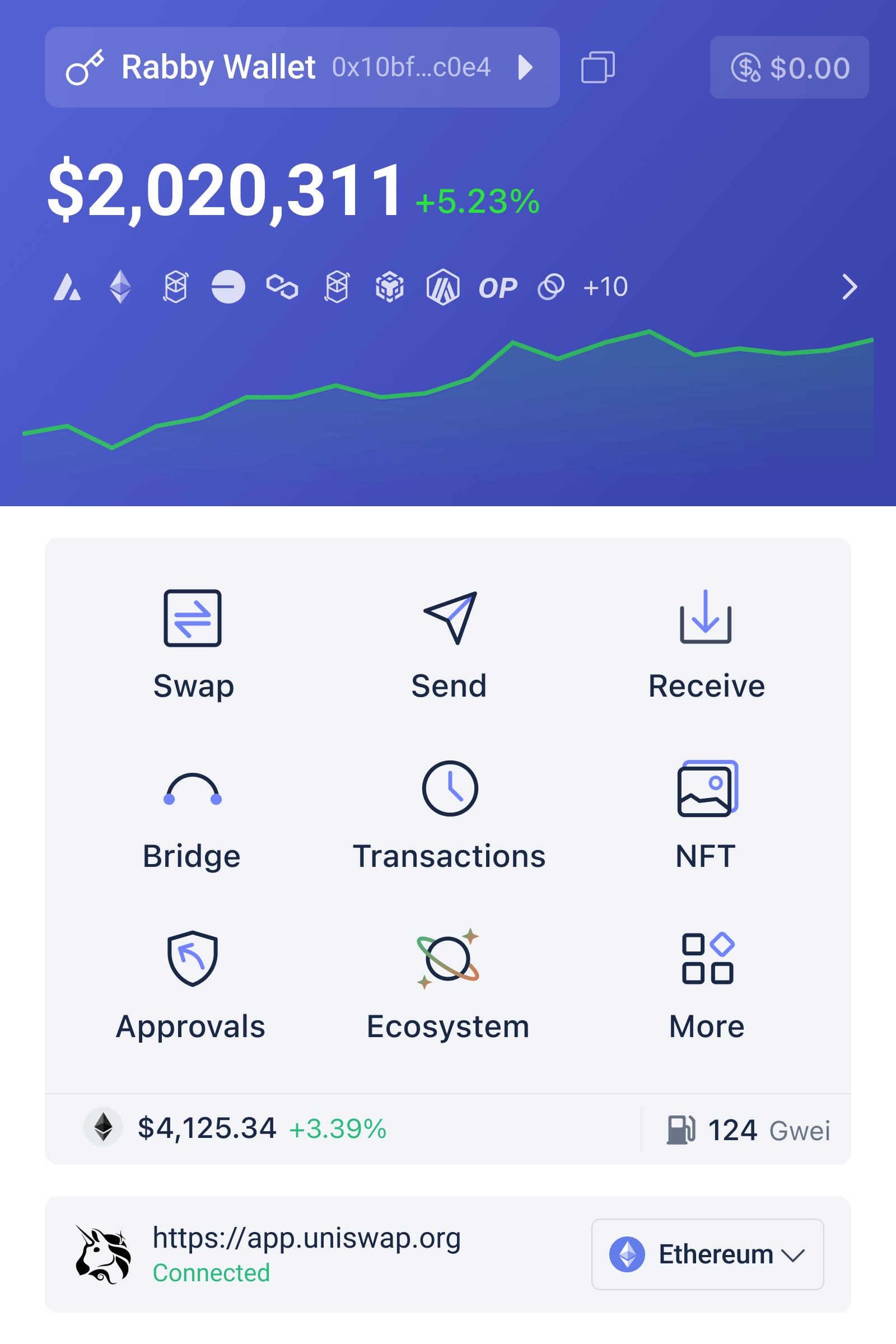
The case: one user, three networks, four different risks
Imagine Maya, who keeps a long-term position in a hardware wallet but uses a browser wallet for smaller, active DeFi transactions. She connects to a decentralized exchange on one network, supplies collateral to a lending protocol on another, and later moves funds through a bridge. From her perspective, this is one portfolio. Technically, it is a collection of separate environments, each with its own chain state, gas token, contracts, fee market, and failure modes.
A multi-chain wallet helps organize that complexity by presenting accounts and networks within one workflow. It can reduce the friction of switching between applications and chain-specific settings. That matters because operational mistakes—using the wrong network, sending an asset to an incompatible address, or overlooking a fee requirement—often arise from context switching rather than from sophisticated attacks.
Rabby is designed for browser-based DeFi use and is commonly considered by users who want more transaction context than a minimal signing prompt provides. Before installing any wallet, a user should verify the source, check the requested browser permissions, and protect the recovery phrase offline. Readers who are evaluating the installation process can review the rabby wallet extension guide, while independently confirming that the download path and software details are authentic.
The important distinction is between visibility and protection. A wallet may identify the destination contract, display expected asset changes, or flag a potentially risky interaction. These signals can make a transaction easier to reason about. They do not prove that the underlying protocol is solvent, that a token will retain value, or that a smart contract has no undiscovered vulnerability. A warning system is an aid to judgment, not a substitute for judgment.
How transaction security works at the signing point
When a user clicks “confirm,” the wallet is not merely transferring money. It may be signing a message that grants a contract permission to move tokens later, calls several contracts in sequence, or changes a position in a lending or derivatives protocol. The visible button on a website can therefore be a poor description of the actual authority being granted.
This is a useful mental model: treat every signature as a capability. A capability is a permission that allows some future action, within defined limits, by a particular address or contract. A token approval, for example, may authorize a smart contract to spend an amount on the user’s behalf. If that permission is broader than necessary, the risk remains even after the original transaction appears complete.
Wallet-level warnings are most helpful when they narrow the gap between the website’s language and the blockchain’s mechanics. They may encourage a user to inspect the contract, notice a suspicious recipient, or reconsider an unexpected asset change. In practice, the quality of the decision still depends on what the wallet can decode, what the application exposes, and whether the chain or contract uses conventions that the wallet recognizes.
That last condition is a real boundary. DeFi is not a single standardized environment. New chains, custom contracts, upgradeable systems, aggregator routes, and complex signature schemes can make interpretation incomplete. A transaction that is clearly displayed is not necessarily economically safe, and a transaction that is poorly displayed is not necessarily malicious. Users should be especially cautious when a wallet cannot explain the outcome in plain terms.
Rabby compared with other wallet arrangements
Minimal browser wallets
A conventional browser wallet can be a straightforward choice for users who value broad application compatibility and a familiar signing flow. Its simplicity may be an advantage: fewer layers can mean fewer interface decisions. The trade-off is that a minimal prompt can leave more investigative work to the user. If someone interacts with many protocols across several networks, the cost of that missing context can become material.
Hardware wallets
Hardware wallets provide a different kind of defense by keeping key operations isolated from an ordinary browser environment. They are generally better suited to long-term holdings and high-value accounts. Yet hardware security does not automatically clarify what a user is signing. A person can still approve a malicious contract, especially when transaction data is difficult to interpret on a small device. The strongest arrangement for many users is layered: a hardware wallet for storage and a separate active wallet for limited DeFi exposure.
Custodial platforms
A US user who keeps funds on a regulated or centralized platform may gain account recovery options and a familiar customer-support model. That convenience comes with counterparty risk: the platform controls the withdrawal process, may restrict access, and creates dependence on its operational and compliance decisions. Self-custody removes that intermediary but transfers responsibility for keys, approvals, network selection, and recovery to the user.
These options are not ranked on one universal security scale. They protect against different threats. A browser wallet can reduce some signing confusion; a hardware wallet can reduce key-exposure risk; a custodial platform can reduce the burden of recovery. The correct comparison is not “which wallet is safest?” but “which failure am I trying to make less likely, and what new failure does that choice introduce?”
Installation is part of the threat model
People often treat installation as a neutral first step, but it is itself a security event. A fake extension can request access to browsing activity, imitate a legitimate wallet, or capture a recovery phrase. The safest workflow is deliberately unexciting: use a trusted project channel, verify the extension identity and permissions, create or import a wallet only in the intended environment, and never enter a recovery phrase into a website, chat, form, or support message.
Separate accounts by purpose. A “hot” account used for testing a new protocol should not hold the same balance as an account used for savings. On a multi-chain wallet, this separation is particularly useful because the interface can make many networks feel like one seamless account. Seamlessness is convenient, but it can also hide how widely risk is distributed. A compromised approval on one chain does not mean every chain is compromised, yet a stolen private key can expose every account controlled by that key.
Users should also inspect allowances periodically and revoke permissions they no longer need, using a trustworthy tool and the correct network. Revocation can require gas and is not a universal cure: it does not recover already-stolen funds, repair a vulnerable protocol, or protect against a fresh approval. Still, reducing dormant permissions limits the number of contracts that can act on an account without a new decision.
What to watch as multi-chain use grows
The likely direction of wallet design is toward more transaction explanation: clearer simulations, better contract labeling, stronger phishing detection, and interfaces that show a proposed state change rather than a block of technical data. If those tools become more reliable, they could shift security from “read the raw transaction” toward “compare the intended outcome with the expected outcome.” That would be meaningful for non-specialists.
The conditional point is important. Better interfaces will help only if their data is timely, their decoding covers the relevant contracts, and users understand uncertainty. Attackers can adapt by using familiar-looking applications, routing transactions through legitimate infrastructure, or exploiting decisions that appear economically reasonable. The next generation of wallets may therefore improve visibility without eliminating social engineering or protocol risk.
For Maya, the practical framework is simple: use a wallet that gives enough context to question a transaction, keep exposure proportional to what she can afford to lose, separate long-term storage from experimentation, and pause whenever the expected result is unclear. A multi-chain wallet is not a safety blanket. It is closer to a dashboard in a complicated vehicle: valuable because it exposes information, but unable to choose the road or prevent the driver from making a bad turn.
Frequently Asked Questions
Is Rabby safer than every other crypto wallet?
No wallet is safest for every use. Rabby may be useful for active, multi-network DeFi because transaction context and network organization can support better decisions. A hardware wallet may be more appropriate for long-term holdings, while a custodial platform may offer easier recovery. Security depends on the threat, the user’s habits, and the applications involved.
Can a wallet warning guarantee that a DeFi transaction is safe?
No. Warnings and simulations can identify suspicious patterns or clarify likely outcomes, but they depend on available data and supported contract behavior. They cannot guarantee that a protocol will function as promised, that a token has liquidity, or that an undiscovered vulnerability does not exist.
Should a beginner use one wallet for all crypto activity?
Usually, separating roles is more prudent. A limited-balance wallet can be used for experimentation and routine DeFi activity, while a higher-value account is kept offline or used rarely. The arrangement adds management overhead, but it limits the damage caused by one mistaken approval or compromised application.